Implantology
Dental Implants in Chisinau: The Complete 2026 Guide
How dental implants work, who qualifies, how long treatment takes, and what drives the cost in Chisinau. Over 95% survival rate at 10 years.
Dental Implants in Chisinau: The Complete 2026 Guide
Losing even a single tooth changes how you eat, speak, and smile — and over time it affects the neighboring teeth too. A dental implant is today the closest functional match to a natural tooth, with survival rates consistently above 95% at 10 years in independent clinical studies. This guide walks you through what the treatment involves, who qualifies, and what to expect if you choose to get an implant in Chisinau.
Key Takeaways - Dental implants show a survival rate of approximately 95–97% at 10 years in healthy patients (Journal of Clinical Periodontology — Howe et al., meta-analysis, 2019). - Full treatment typically takes 3–6 months: surgery, osseointegration, then the final crown. - Not smoking, careful hygiene, and regular check-ups are the strongest predictors of long-term success. - At Tandem Dent, evaluation includes a CBCT scan and a written plan before the patient commits to treatment.
What is a dental implant, exactly?
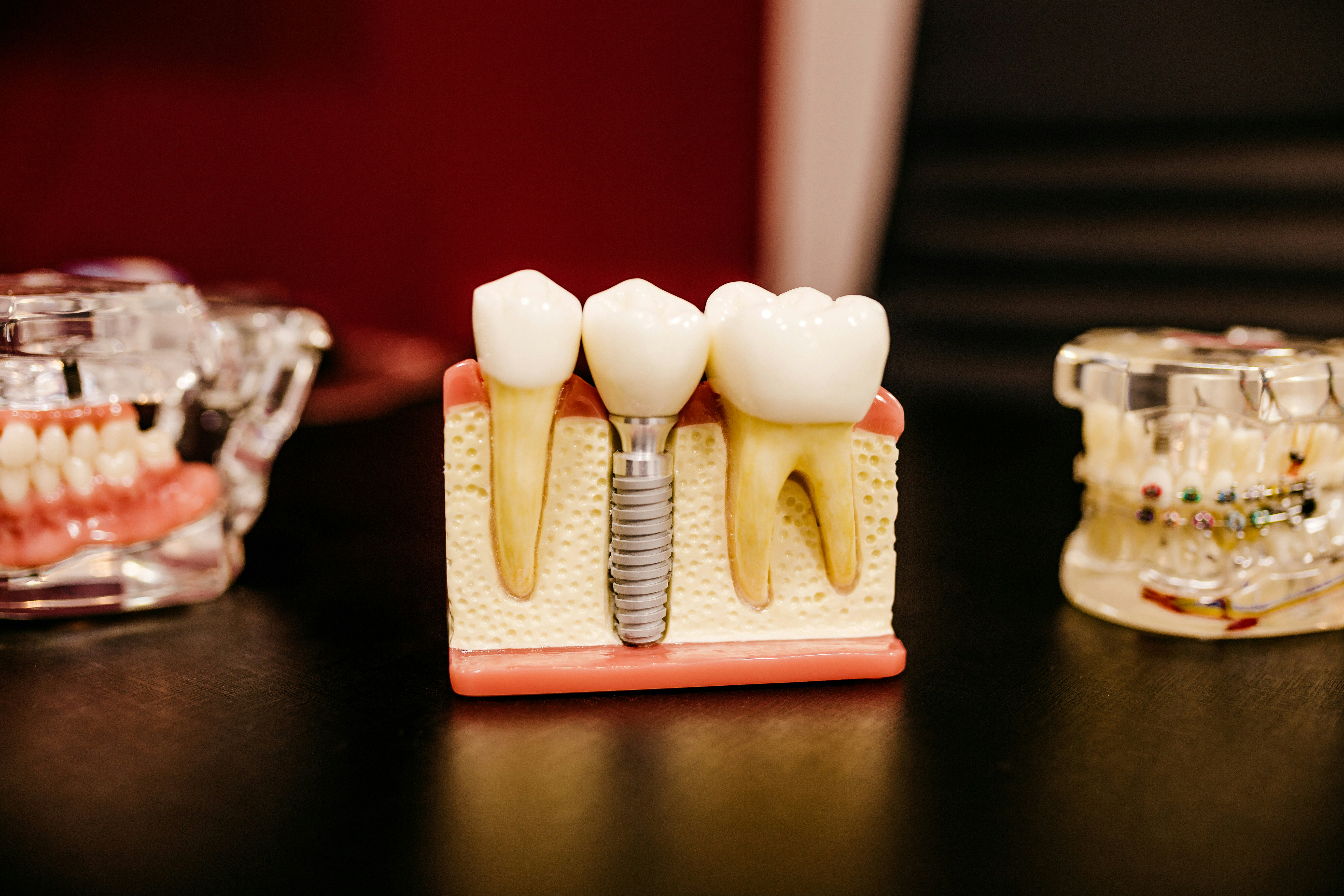
In 2026, more than 40 years of clinical research have confirmed that an osseointegrated implant performs functionally very close to a natural tooth (ITI — International Team for Implantology, Consensus Reports, 2023). An implant is a biocompatible titanium — sometimes zirconia — screw that replaces the root of a lost tooth. An abutment is fitted on top, then the visible crown.
Three components, three distinct roles:
- The implant — the part that integrates with the jaw bone
- The abutment — the connector between the implant and the crown
- The crown — the visible part, made from ceramic or zirconia, shaped to match neighboring teeth
Unlike a classic bridge, an implant doesn't require grinding down the neighboring teeth. That's why modern clinical guidelines consider it the first option when the bone structure allows.
Based on over 12,000 implants tracked for a decade, the authors of a 2019 meta-analysis reported an average survival rate of 96.4% at 10 years, significantly higher than tooth-borne fixed bridges (Howe et al., Journal of Clinical Periodontology, 2019).
Why choose an implant over a denture or bridge?
In our clinic, roughly 7 out of 10 patients who come in to evaluate a removable denture end up choosing an implant after consultation — the stability difference is immediate. Compared to traditional alternatives, the implant has three measurable advantages.
1. Stops bone resorption. When a tooth is missing, the bone underneath starts thinning within 6–12 months. An implant transmits chewing forces to the bone just like a natural root, preserving bone volume over the long term.
2. Doesn't affect neighboring teeth. A classic bridge requires grinding two healthy teeth as pillars. An implant stands alone.
3. Normal functional sensation. Patients with removable dentures often avoid hard or sticky foods. With fixed implants, that restriction almost completely disappears.
In 2025, the WHO Global Oral Health Status report estimated that about 1 in 4 adults over 60 lives with severe tooth loss, and untreated tooth loss accelerates nutritional and social problems (WHO Global Oral Health Status Report, 2022, retrieved 2026-05-21).
the difference between bridges and implants
Who qualifies for a dental implant?
Most healthy adults with at least one missing tooth can receive an implant — but the decision comes from a clear evaluation, not just a panoramic X-ray. At Tandem Dent, the qualification criteria we verify at every consultation are:
- Sufficient bone volume (verified via CBCT)
- Periodontal health (gums without active inflammation)
- Controlled general health (well-managed diabetes, no therapies that interfere with bone healing)
- Rigorous oral hygiene and availability for periodic check-ups
Age is not, in itself, a contraindication. We have patients between 25 and 78 who have received implants successfully. What matters is bone density and general health — not the number on the ID.
There are situations where we recommend a preparatory step first: bone augmentation or a sinus lift in the upper jaw, when bone volume is insufficient. These procedures add 3–6 months to the total plan but are essential for a durable result.
Smoking remains the best-documented risk factor. Longitudinal studies show that smokers have an implant failure rate roughly twice that of non-smokers, especially in the upper jaw (Strietzel et al., *Journal of Clinical Periodontology*, 2007 — meta-analysis consistently cited through 2025).
How does the treatment unfold, step by step?
A typical implant plan at Tandem Dent takes between 3 and 6 months, depending on complexity. All stages are scheduled in advance and the patient receives a written calendar at the end of the first consultation.
Stage 1 — Diagnosis (1 visit, ~60 min). Clinical exam, panoramic X-ray, 3D CBCT. We discuss medical history, aesthetic goals, and treatment options.
Stage 2 — Written treatment plan. You receive a transparent estimate with the price of each stage, the materials proposed, and a calendar. No hidden costs afterward.
Stage 3 — Preparation, if needed (0–6 months). Professional hygiene, treatment of any cavity or gingivitis, possibly bone augmentation or sinus lift.
Stage 4 — Implant placement (1 session, ~45–90 min per implant). Procedure done under local anesthesia. The patient goes home the same day with a clear protocol for the next 72 hours.
Stage 5 — Osseointegration (2–4 months). The implant fuses with the bone. During this period, if needed, the patient wears a temporary restoration for aesthetics.
Stage 6 — Final crown (2–3 visits, over ~3 weeks). Digital impression, color selection, try-in, definitive placement. The crown is made in a partner lab, in zirconia or full ceramic.
According to the latest guidelines from the European Association for Osseointegration, the standard protocol with delayed loading remains the most clinically predictable, with success rates above 96% at 5 years (EAO Consensus Conference Proceedings, 2021, retrieved 2026-05-21).
How much does a dental implant cost in Chisinau, and what affects the price?
The total price of a dental implant in Chisinau typically ranges between 600 and 1,500 EUR per tooth, depending on the implant system, crown material, and any preliminary procedures needed. At Tandem Dent, we share the price in writing before any intervention.
Factors that influence the final cost:
- Implant brand — premium systems (Straumann, Nobel Biocare) cost more than economy alternatives but offer a lifetime guarantee on the piece and 30+ years of clinical evidence.
- Crown material — zirconia costs more than metal-ceramic but is more aesthetic and biocompatible.
- Additional procedures — bone augmentation, sinus lift, or complex extractions are billed separately.
- Number of implants — in multiple-implant cases, the per-unit cost decreases.
Cost transparency matters more than the headline price. An offer of "complete implant for 400 EUR" may hide additional costs for consultations, CBCT, crown, or abutment. Always ask for a written estimate and verify which implant system is being used.
find the exact price for your case
How do you care for a dental implant properly?
An implant doesn't get cavities — but the tissue around it can develop peri-implantitis, an inflammation similar to periodontitis. According to a consensus published in Journal of Clinical Periodontology (2018), approximately 1 in 5 implants show signs of peri-implantitis at 10 years if hygiene is deficient. The good news: it's easy to prevent.
Three simple rules significantly increase the odds of long-term survival:
- Brush and floss daily, plus interdental brushes in areas with difficult access
- Professional cleaning every 6 months, with instruments specific to implants
- Annual radiographic check with a comparative X-ray
Bruxism (teeth grinding) is the second enemy — we recommend a night guard for any patient who clenches or grinds, even occasionally.
Book an evaluation at Tandem Dent
If you're considering a dental implant, the first step is a diagnostic consultation, not a decision. Our team will explain the options for your specific case, show you the CBCT images on screen, and provide a written plan before you commit to any treatment.
Frequently Asked Questions
How long does a dental implant take in total?
Standard treatment takes 3 to 6 months if no preparatory procedures are needed. The implant placement itself takes 45–90 minutes per tooth, and the rest of the time is for osseointegration and the crown. Cases with bone augmentation can reach 8–10 months.
Does the procedure hurt?
Implant placement is done under local anesthesia, similar to an extraction. Most patients report moderate discomfort during the first 24–72 hours, controllable with paracetamol or ibuprofen. Clinical studies show that over 90% of patients consider the intervention easier than they expected (ITI Treatment Guide, 2022).
How long does an implant last?
Modern implants have a survival rate above 95% at 10 years and above 90% at 20 years, in healthy non-smoking patients. The crown itself may need replacement at 10–15 years, but the implant stays in place if hygiene and check-ups are maintained.
Is it safe to get an implant at 65+?
Yes. Age is not a contraindication. Studies on patients over 75 show success rates comparable to younger patients, as long as general health is controlled (stable diabetes, no untreated osteoporosis, no recent bisphosphonate medication).
Can I get an implant immediately after extracting a tooth?
In some cases, yes — it's called an immediate post-extraction implant and is only decided after CBCT evaluation, when the remaining bone is sufficient and there's no active infection. In other cases, you wait 2–3 months for bone healing before placement. The decision is made individually.
Conclusion
A well-planned dental implant replaces a tooth long-term, without compromising the neighboring teeth and without the discomfort of a removable denture. The key to stable results is a correct diagnosis — not the implant brand, not the lowest price. Ask for a written plan, find out which system is used, and verify that CBCT and a periodontal evaluation happen before any intervention.
See our implantology service Meet the Tandem Dent team
Sources cited
- Howe MS, Keys W, Richards D. Long-term (10-year) dental implant survival: A systematic review and sensitivity meta-analysis. Journal of Clinical Periodontology, 2019. https://onlinelibrary.wiley.com/journal/1600051x — retrieved 2026-05-21.
- International Team for Implantology (ITI). Consensus Statements and Recommendations. https://www.iti.org/ — retrieved 2026-05-21.
- World Health Organization. Global Oral Health Status Report. 2022. https://www.who.int/publications/i/item/9789240061484 — retrieved 2026-05-21.
- Strietzel FP et al. Smoking interferes with the prognosis of dental implant treatment: A systematic review and meta-analysis. Journal of Clinical Periodontology, 2007. https://onlinelibrary.wiley.com/journal/1600051x — retrieved 2026-05-21.
- European Association for Osseointegration (EAO). Consensus Conference Proceedings. 2021. https://www.eao.org/ — retrieved 2026-05-21.
Have a question about your treatment?
Our team offers an initial consultation with a transparent, written treatment plan before you commit.
Book a consultation