Aesthetic Dentistry
Teeth Whitening: The Complete, Safe, Myth-Free Guide
How dental whitening actually works, which methods are clinically effective, what it costs in Chisinau, and how to avoid post-treatment sensitivity.
Teeth Whitening: The Complete, Safe, Myth-Free Guide
Whitening is one of the most requested aesthetic procedures — and one of the most misunderstood. Baking soda, charcoal, supermarket gels: most "viral solutions" either don't work or damage enamel. This guide explains how professional whitening works, which method is right for your case, and how to avoid the most common problems.
Key Takeaways - Professional whitening uses hydrogen peroxide or carbamide peroxide — the only substances with clinically proven efficacy (Cochrane Oral Health Group, *Home-based tooth bleaching*, 2018, retrieved 2026-05-21). - An in-office procedure takes about 60–90 minutes and produces 4–8 shades of lightening on the VITA scale. - Temporary sensitivity is the most common side effect, but it resolves within 24–48 hours. - Whitening doesn't change the color of crowns, veneers, or fillings — only natural teeth.
How does dental whitening actually work?
Professional whitening uses a peroxide-based gel that penetrates the enamel into the dentin, where it breaks down the pigment molecules responsible for yellowing. The result isn't a coating — it's a chemical reaction that's reversible over time.
There are two clinically proven active substances:
- Hydrogen peroxide (15–40% concentrations in office) — fast action, used for in-clinic whitening
- Carbamide peroxide (10–22% concentrations in home trays) — slower action, gentler for sensitivity
According to a 2020 meta-analysis published in Journal of Dentistry, both methods produce clinically similar results at 6 months, with a slight difference in speed (Journal of Dentistry, systematic review, 2020, retrieved 2026-05-21). The rest of the popular products — baking soda, activated charcoal, coconut oil — have no clinical evidence of efficacy and some are abrasive.
What real options exist, and which one fits your case?
In 2026, there are three clinically validated approaches — each with its own indications.
1. In-office professional whitening. A 60–90 minute session with a high-concentration gel, gingival isolation, and sometimes LED or laser activation. Visible result immediately. Recommended when you need a fast result for an event.
2. Take-home whitening with custom trays, supervised by your dentist. The dentist takes an impression and makes custom trays. At home, the patient applies 10–16% carbamide peroxide gel for 1–2 weeks, 30–60 minutes per day. Gradual result, gentler for sensitivity.
3. Combined whitening. We start with an in-office session and continue with home trays for 7–10 days. The most durable long-term strategy, per AAED academy protocols.
A 2025 study published in Journal of Esthetic and Restorative Dentistry compared 320 patients over 24 months: combined whitening retained the result 35% better than in-office alone (Journal of Esthetic and Restorative Dentistry, 2025, retrieved 2026-05-21).
Who is NOT a candidate, and why?
Not all patients can safely undergo professional whitening. The initial evaluation checks four things.
- Cavities or old fillings — must be treated first; the gel penetrates through any defect and produces acute pain
- Severe gingival recession — the exposed root is very sensitive to peroxide
- Pregnant or breastfeeding women — without sufficient safety data, we recommend postponing
- Patients under 18 — enamel isn't fully matured
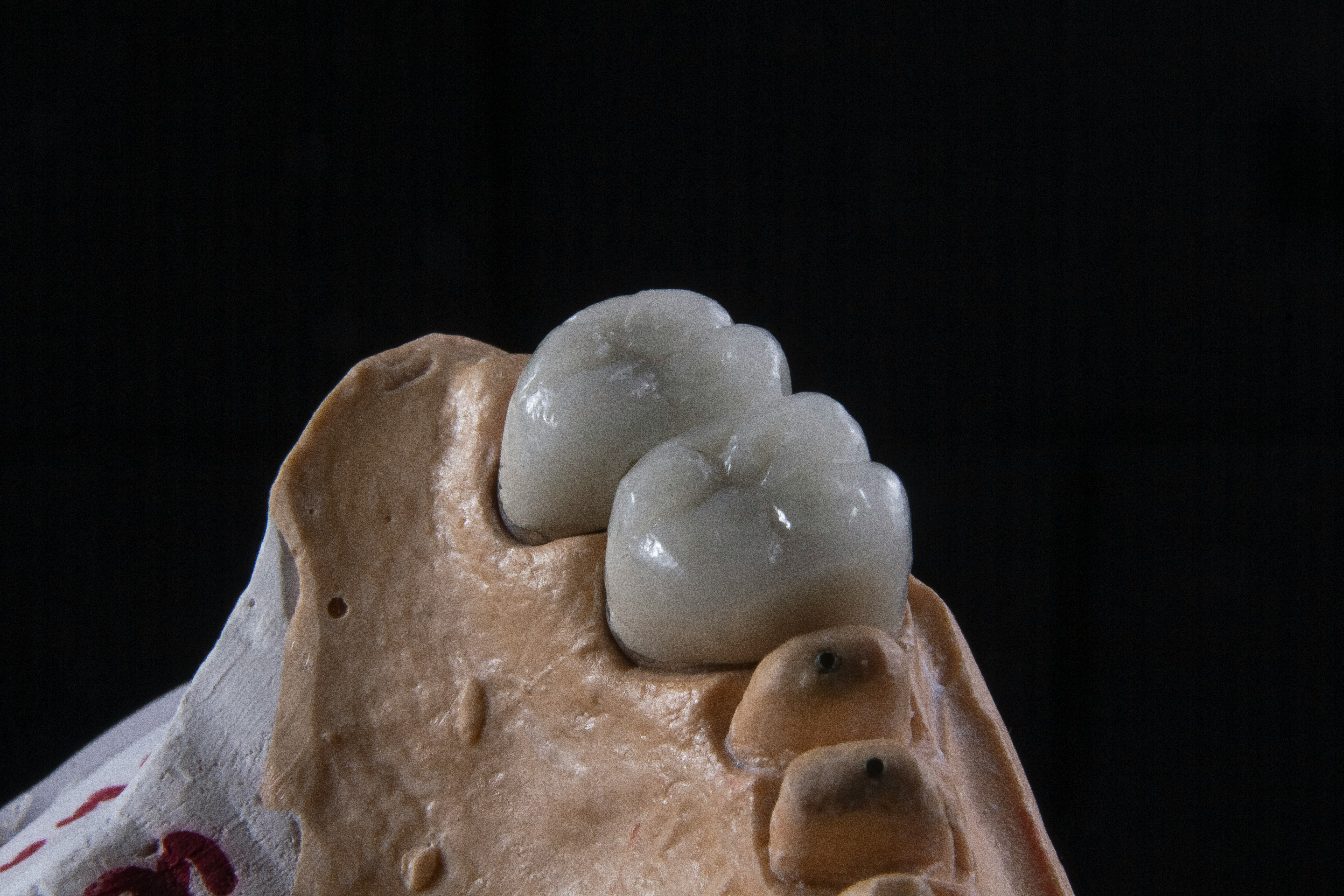
In addition, veneers, crowns, composite fillings, and zirconia veneers don't whiten. If you have visible restorations like these, we'll discuss whether whitening the surrounding natural teeth produces an inconsistent shade — sometimes the right solution is replacing the restoration after whitening, not whitening it.
How does professional whitening unfold at Tandem Dent?
Our standard process takes 3 visits, spread over about 2–3 weeks:
- Consultation and diagnosis (45 min). We check for cavities, sensitivity, existing restorations, and starting color on the VITA scale. We discuss expectations.
- In-office whitening session (75 min). Gingival barrier isolation, gel application, optional activation, 3 cycles of 15 minutes. Immediate photo-documented result.
- 1-week check-up (20 min). We check sensitivity, finish with desensitizing gel, and provide maintenance recommendations.
If you choose the combined option, after the first session you receive custom trays for the following 7–10 days.
How much does teeth whitening cost in Chisinau?
The total price of professional whitening in Chisinau typically ranges between 3,000 and 6,500 MDL, depending on the method and product used. At Tandem Dent, the price includes the consultation, isolation, whitening material, and follow-up.
For orientation:
- At-home whitening with trays — mid-range price, gradual result, ideal for patients with sensitivity
- In-office whitening, single session — higher price, immediate result
- Combined package (office + trays) — best ratio between result and durability
Be careful with very cheap promotions. Unknown gels without gingival isolation or without a preliminary diagnosis can cause chemical burns on the gum and prolonged sensitivity. Always ask for the exact name of the product used and verify that the treatment is performed by a dentist, not by auxiliary staff.
Sensitivity, myths, and what actually works
About 6 out of 10 patients report mild to moderate sensitivity in the first 24–48 hours. The good news: it's easy to manage.
What works:
- Pastes with potassium nitrate or arginine one week before and 2 weeks after
- Desensitizing gel applied by the dentist at the end of the session
- Avoiding very cold or very hot drinks for 48 hours
What does NOT work (popular myths):
- Baking soda whitens durably. It only removes external stains, like a gentle polish. It doesn't change the base shade.
- Activated charcoal is natural and safe. It's abrasive. In vitro studies show enamel loss 2–4 times higher than normal pastes.
- Cheap LED whitening at home works. Peroxide concentrations in over-the-counter kits are too low for clinically significant results.
How do you keep the result as long as possible?
Dental whitening lasts between 6 months and 2 years, depending on habits. Three simple rules extend the duration.
- Week 1 after whitening — avoid coffee, red wine, black tea, soy sauce, curry. Enamel is temporarily more porous.
- Monthly — use a paste with hydroxyapatite or fluoride to strengthen enamel.
- Every 6 months — professional check-up. At Tandem Dent we recommend a short annual "touch-up" session for patients who want to maintain the initial shade.
Frequently Asked Questions
How long does the whitening result last?
Between 6 months and 2 years, depending on daily hygiene and consumption of coffee, wine, and tobacco. Patients who smoke or drink coffee several times a day notice color relapse faster. A short annual "touch-up" session lasts 30–45 minutes.
Does whitening destroy enamel?
No, if done properly. Clinical studies using electron microscopy over more than 15 years of professional whitening have not identified significant enamel loss or hardness reduction at medically used concentrations. The real risk appears with unsupervised products or abusive concentrations.
Can I whiten my teeth while wearing braces?
Not during orthodontic treatment — braces block uniform gel application. Ideally, schedule whitening after orthodontic completion, when teeth are aligned and surfaces fully exposed.
Does whitening work on heavily tetracycline-stained teeth?
Partially. Teeth affected by tetracycline have pigment in the deep dentin structure and respond more slowly to whitening. Treatment can take 6–8 weeks of home trays, and sometimes the better solution is veneers. The decision is made after diagnosis.
Conclusion
Professional whitening is safe, effective, and predictable — but only after diagnosis. Before any procedure, check whether there are cavities or old fillings that need treatment, choose a method suited to your sensitivity, and ask for the written price of the entire package. A visible result matters, but enamel safety matters more.
Book an aesthetic consultation See all articles
Sources cited
- Cochrane Oral Health Group. Home-based tooth bleaching versus no treatment. 2018. https://www.cochranelibrary.com/ — retrieved 2026-05-21.
- Journal of Dentistry. Systematic review on hydrogen peroxide vs. carbamide peroxide bleaching outcomes, 2020. https://www.journals.elsevier.com/journal-of-dentistry/ — retrieved 2026-05-21.
- Journal of Esthetic and Restorative Dentistry. Long-term color stability of combined in-office and at-home bleaching, 2025. https://onlinelibrary.wiley.com/journal/17088240 — retrieved 2026-05-21.
- American Academy of Esthetic Dentistry (AAED) — Clinical protocols on tooth whitening, 2024 update. https://www.estheticacademy.org/ — retrieved 2026-05-21.
Have a question about your treatment?
Our team offers an initial consultation with a transparent, written treatment plan before you commit.
Book a consultation